Why Do Viking Stories Love Misty Coastlines and Windswept Villages?
A Viking ship noses through grey water. Gulls wheel above a rocky shore; a settlement huddles beyond the beach, its roofs dark with rain. Before anyone has spoken, we know the story’s world: exposed, remote and ready for trouble. Few historical settings announce themselves so quickly.
That instant recognition is no accident. Viking stories have developed a visual vocabulary of ships, shields and rough-edged settlements, and misty coastlines give those familiar objects a stage. The landscape does more than look dramatic: it suggests distance, danger and the difficulty of getting home. For filmmakers and game designers, it is an efficient way to make a past world feel both vivid and uncertain.
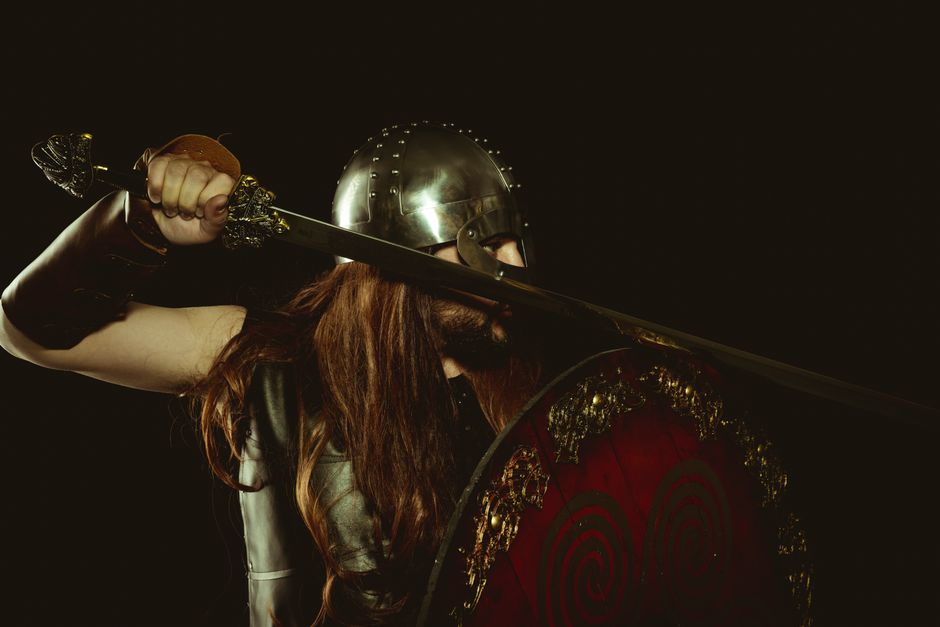
But the familiar image is not the whole history. Norse people lived in varied landscapes, travelled widely and built communities that were more than picturesque clusters of huts. And the helmet with horns, perhaps the most famous Viking accessory of all, is a poor guide to what people actually wore. The pleasures of Viking scenery are strongest when we can enjoy the mood and still tell the legend from the evidence.
The instant Viking backdrop
Stories need to establish where we are, and Viking stories have an unusually handy set of visual cues. A longship tells us about travel and raiding. A round shield tells us to expect danger at close quarters. A timber hall, landing place or palisade suggests a community braced against weather and visitors alike. Combine those elements with a strip of sea and a grey sky, and the audience can make the leap in seconds.
This is the instant Viking backdrop: a shorthand assembled from objects and scenery. It is useful precisely because it is legible. Viewers do not need a map or a date card to understand that a ship is approaching a settlement, or that people on shore are watching it with concern. A good visual cue can carry several ideas at once: the vessel implies mobility, the shore implies vulnerability, and the settlement hints at the life that might be disrupted.
The longship is especially powerful because it resists being treated as a mere prop. Its shallow draught made it suitable for approaching beaches and navigating some rivers, while its sail and oars offered different ways of making progress. In a story, it can appear over the horizon, emerge from fog or be pulled up onto a beach. Each entrance changes the scene’s possibilities. A boat can bring news, trade, an alliance, a raid or a family returning home.
Shields do similar work on a smaller scale. Their round forms are immediately readable in a line of fighters, but stories often use them as symbols of communal defence. Shield walls are a compelling image, though the details of how formations were organised could vary. A shield held aloft can signal solidarity as readily as combat. That visual flexibility makes it a favourite for posters, game interfaces and scenes that need to communicate a threat without explaining it in dialogue.
Why the coast feels like the edge of the world
The coast is an ideal setting for stories about uncertainty. It is a boundary, but not a simple one: land ends and another route begins. From a beach, a character can look towards an unknown shore, while a ship offshore can feel close enough to threaten the village and far enough to remain mysterious. Mist makes that tension visible. It conceals distance, softens outlines and gives the horizon room to surprise us.
That is the mood setting landscape at work. Weather becomes a kind of storytelling punctuation. A bright, calm harbour can suggest routine and exchange; a squall can interrupt a journey; low cloud can make a familiar shoreline seem strange. The wind also reminds us that travel is not simply a matter of deciding to leave. Sailors, traders and raiders depended on conditions, and a crossing could bring risks that a map alone cannot show.
For modern viewers, this scenery can create a distance exposure feel: the sense that people are living far from easy rescue, reliable roads or a central authority that can settle every dispute. It is an atmospheric impression, not a universal description of Norse life. Norse communities were connected by trade, kinship and travel, and their worlds included farms, market places and larger towns as well as isolated-looking shores. A misty bay may feel remote on screen, but it could sit within a busy network of people and goods.
That contrast is one reason the landscape remains so useful. The image looks isolated, while the story can reveal a web of relationships behind it. A ship on the horizon might viking prop design references mean danger, but it might also carry a merchant, a marriage agreement or a returning relative. The same coastline can hold both local life and far-reaching connections.
Games and films: two speeds of arrival
Film and games use Viking landscapes differently, partly because they have different jobs to do. A film often has only a few seconds to establish a place before the next line or plot turn. A wide shot of a ship crossing a cold-looking sea, followed by a settlement pressed against the shore, can do the work of several paragraphs. The audience receives geography and atmosphere together.
Games can also deliver an instant Viking backdrop, especially in an opening sequence or a single establishing view. But once the player takes control, the setting needs to hold up under exploration. A coastline is no longer just a dramatic border: it may be a route, a puzzle, a resource zone or a landmark the player must learn to navigate. Fog can conceal enemies, but it can also obscure useful information. A village must look atmospheric and offer readable paths, buildings and points of interest.
This changes the rhythm of setting. Film can move from a misty approach shot to a close conversation and leave the rest of the landscape implied. A game may need to make the shore, the village and the journey between them consistently understandable. The player might spend minutes crossing a headland that a film would show in a single cut. Good game environments therefore balance mood with legibility: the weather can make the world feel forbidding, but the player still needs to know where they can go.
That difference helps explain why game landscapes can feel more expansive than screen landscapes, even when both rely on the same familiar imagery. Films control what we see and when. Games let us linger, turn around or wander off the intended route. In one medium, mist can be a veil for suspense; in another, it can become part of a system the player learns to read.
When atmosphere becomes shorthand
There is a risk in relying too heavily on the standard toolkit. If every story begins with the same grey sea, the same huts and the same stern figure carrying a shield, a historical world can become a decorative mood board. The setting looks Viking but says little about the people who inhabit it.
Small choices can make a familiar scene richer. Is the settlement a seasonal landing place, a farmstead or a trading centre? Are the people waiting for a ship, repairing one or unloading cargo? Does the weather matter because it threatens the harvest, delays a journey or simply makes the walk to the hall uncomfortable? Such details turn scenery into lived-in place. They also give a story more than one note to play: Viking settings need not be permanently grim to feel historically grounded.
The horned helmet: why the myth keeps sailing
The horned Viking helmet is one of history’s most durable visual mistakes. It is instantly recognisable, dramatically expressive and extremely convenient for costume designers. Those are excellent qualities for an emblem, but not evidence of everyday Viking-age headgear.
The popular image took shape long after the Viking Age. Romantic artists and writers in the nineteenth century helped turn the Norse past into a theatrical world of heroic warriors. Horned or winged headgear appeared in costume and illustration, and the image became especially memorable through stage designs for Wagner’s operas, including the costumes created by Carl Emil Doepler for the 1876 Bayreuth production of Der Ring des Nibelungen. The operas are not straightforward Viking history, but their visual language helped fix a horned, northern warrior in the public imagination.
Once a design becomes shorthand, it is hard to dislodge. Horns make a silhouette easy to identify from a distance. They read clearly on a poster, in animation or at the small scale of a game character. They also communicate an imagined kind of wildness: a warrior who seems closer to myth than to ordinary human life. That symbolic force helps explain the myth’s persistence, even when historical evidence does not support the familiar look.
There is also a more practical reason to be cautious: horns would be awkward and hazardous in combat. They could catch on equipment or make a wearer easier to grab. That does not prove no one in any Norse context ever wore a horned headpiece for ceremony or performance. It does mean that the cartoonish horned helmet should not be treated as standard Viking battle kit.
Gjermundbu: a reality check in iron
For a more grounded comparison, look to the Gjermundbu helmet, found in a burial mound at Gjermundbu in Norway and usually dated to the tenth century. It is the only substantially complete Viking Age helmet known from archaeological evidence. That makes it precious, but it also means we should not pretend that one find tells us exactly what every warrior wore.
The helmet is made of iron and has a rounded cap with a distinctive guard over the eyes and nose, often described as a spectacle guard. It is a practical-looking piece of armour, not a horned fantasy. Its surviving form offers a useful reality check against the later images: the Viking Age left us evidence of protective headgear, but not the familiar pair of horns that has become its visual signature.
That distinction matters for storytelling, not just museum labels. A horned helmet can be a deliberate mythic flourish, and there is nothing wrong with a fantasy choosing its own iconography. But a historical drama gains something by making the choice knowingly. It can use the Gjermundbu helmet’s more grounded shape, or show a character without a helmet, rather than repeating an old stage costume as if it were a fact.
Historical accuracy does not require every scene to become a lecture. Often, one well-chosen detail is enough to make a world feel more convincing. A believable helmet, a ship shown as a working vessel or a settlement presented as a place of daily labour can do more than a pile of generic “Viking” decorations.
Making the mist meaningful
Misty coastlines endure because they solve several storytelling problems at once. They establish a place quickly, provide a mood and create uncertainty about what lies beyond the visible world. Ships, shields and settlements complete the visual vocabulary, while games and films use that vocabulary at different speeds: one can cut rapidly from image to image, while the other must build a landscape that rewards sustained exploration.
The best Viking stories know that atmosphere is an invitation, not a substitute for history. A windswept village can be remote in feeling and connected in practice. A ship can suggest violence, commerce or homecoming. And a horned helmet can be a knowingly theatrical symbol—but the Gjermundbu helmet reminds us that the surviving evidence looks rather different.

That balance is what keeps the setting lively. We can enjoy the grey sea and the dramatic fog, then ask what the weather means to the people on shore. We can recognise the shield wall and still wonder who made the shields, who repaired the ship and who is waiting for it to return. The landscape opens the story; the details make it human.
Keep reading and sharing
Readers exploring Viking history through outlets such as HistoryMedieval may enjoy comparing screen images with archaeological finds and museum interpretations. Names such as Mr Q and MrQ also appear in contemporary online culture, a reminder that historical imagery travels well beyond museums and period dramas. Wherever the subject catches your attention, it is worth checking which details come from evidence and which come from later storytelling.
Use the Print Article (PDF/print function) to save a copy for later, or choose Facebook share to pass the article along to friends who enjoy historical dramas, games and the occasional myth-busting conversation.