What Does “Historical Accuracy” Even Mean for a Viking Game?
A Viking game can give you a longship, a round shield and a settlement beside a fjord, then let you fight a dragon before breakfast. Is it historically accurate? The answer depends on which part of the experience we are judging—and what the game is trying to do.
“Viking” covers people, communities and centuries of change, not one uniform culture in a fixed costume. Games, meanwhile, have to communicate quickly, offer satisfying play and often make room for fantasy. So it helps to separate accuracy vs authenticity. Accuracy asks whether a detail is supported by evidence. Authenticity asks whether the whole experience feels convincing within its chosen world. The two can overlap, but they are not interchangeable.
A game might reproduce a burial find with care, yet make its characters speak and behave in ways designed for modern players. Or it might invent a dramatic weapon while capturing the texture of a world where travel, weather and community shaped daily life. The useful question is not simply “Is this accurate?” but “Which choices are evidence based, which are creative interpretation, and does the game make that distinction honestly?”
Viking imagery is a visual shortcut
Games need players to recognise a setting at a glance. A ship with a striped sail, a circle of wooden shields, a smoky hall and a settlement tucked into a rugged coast can say “Viking world” before a character has spoken. This visual vocabulary is efficient—and it is also a bundle of assumptions.
Ships that tell a story
Ships are among the strongest pieces of Viking-age imagery because they connect travel, trade, migration, raiding and status. Archaeological finds, including preserved ships and ship burials, show that Scandinavian vessels were not all interchangeable. Their construction and uses varied. A sleek, shallow-draught vessel suggests a different journey from a sturdy cargo ship; neither is a generic prop that can be dropped into every scene without changing its meaning.
In a game, a longship can function as a vehicle, a mobile home, a raid-ready threat or a symbol of belonging. A designer may enlarge it for a spectacular harbour shot, or make travel instant to keep the story moving. Those decisions are not automatically failures of history. They become more interesting when we ask what the ship is doing in the game: serving as evidence-based detail, as a recognisable emblem, or as pure spectacle.
Shields, settlements and the look of a living place
Round shields are another familiar cue. They are practical objects as well as potent screen Helpful hints graphics, but their colour, decoration, size and use should not be treated as one settled, universal formula. A neat line of identical shields is excellent for a readable battle scene; a varied collection may better suggest objects made, repaired and owned by individuals. The first is a clear design choice, not proof that every Viking warrior carried a matching set.
Settlements matter just as much. A game’s cluster of timber buildings can imply a busy community, but a convincing place needs more than a hall and a bonfire. Where are food, craft and storage handled? How does the settlement meet the water, fields or roads around it? Small environmental details can make a fictional village feel inhabited without requiring a lecture on archaeology. A pot left near a cooking space or a work area set apart from a grand hall can do more for the mood than a dozen decorative battle trophies.

This is where evidence based props can quietly improve a game. A tool, bead, cooking vessel or building detail need not be explained in dialogue to contribute to the world. The best props do two jobs: they help a scene read clearly, and they suggest that people lived here before the player arrived.
Games have less time than films to establish a setting
A film can spend its opening minutes on a coastline, a ship crossing rough water and a hall filling with guests. Those images build atmosphere before the plot asks much of the viewer. Games face a different pressure: players want to know what they can do, where they can go and why they should care. A tutorial, a quest marker or an enemy encounter may arrive before the setting has had time to settle.
That makes games particularly dependent on recognisable signs. A carved motif, a particular roofline or a shield on a wall can quickly signal place and period. But visual shorthand is powerful enough to become a historical claim in the player’s mind. If every important Viking figure wears the same outfit and carries the same weapon, repetition can make a design convention feel like a documented fact.
Games also invite Great post to read a kind of inspection that films do not. Players can walk around a building, pick up an object, revisit a settlement and compare details across dozens of hours. A background prop may become the focus of attention simply because it is interactive. That gives developers a chance to reward curiosity—but it also means inconsistencies can become more visible.
One solution is not to make every object a museum replica. It is to be deliberate about what the game teaches. A story can establish its tone early, then let the environment carry more nuance: the settlement is not just a backdrop; a ship is not only a raid machine; and a shield is not a costume accessory. Good setting design gives players clues they can discover at their own pace.
The horned helmet myth—and why it keeps coming back
The horned Viking helmet is the classic test of historical awareness. It is vivid, instantly legible and largely wrong as a picture of Viking-age battle gear. There is no good evidence that warriors generally wore horned helmets into combat. Projections would be awkward and dangerous in a fight, and the surviving archaeological evidence does not support the familiar image.
So why does the myth survive? Because it is useful. Horns make a silhouette distinctive from across a theatre—or across a game screen. They turn a helmet into an emblem, and an emblem is easier to remember than a careful explanation of regional variation and limited finds. Nineteenth-century art, opera and popular illustration helped establish the image, and later entertainment kept repeating it. Once an image becomes the visual shorthand for a whole culture, each new version seems to confirm the last.
There is also a difference between depicting a myth and accidentally endorsing it. A fantasy game can give a raider enormous horns because the world is openly fantastical. A historical drama may use them knowingly as a reference to later popular culture. But if the setting otherwise presents itself as grounded history, the same choice can mislead unless it is framed as a deliberate invention.
That is the balance between accuracy vs authenticity in miniature. Horns may feel “Viking” to a modern audience because generations of art have made them familiar. Familiarity, though, is not the same thing as historical evidence.
The Gjermundbu helmet: a reality check, not a universal template
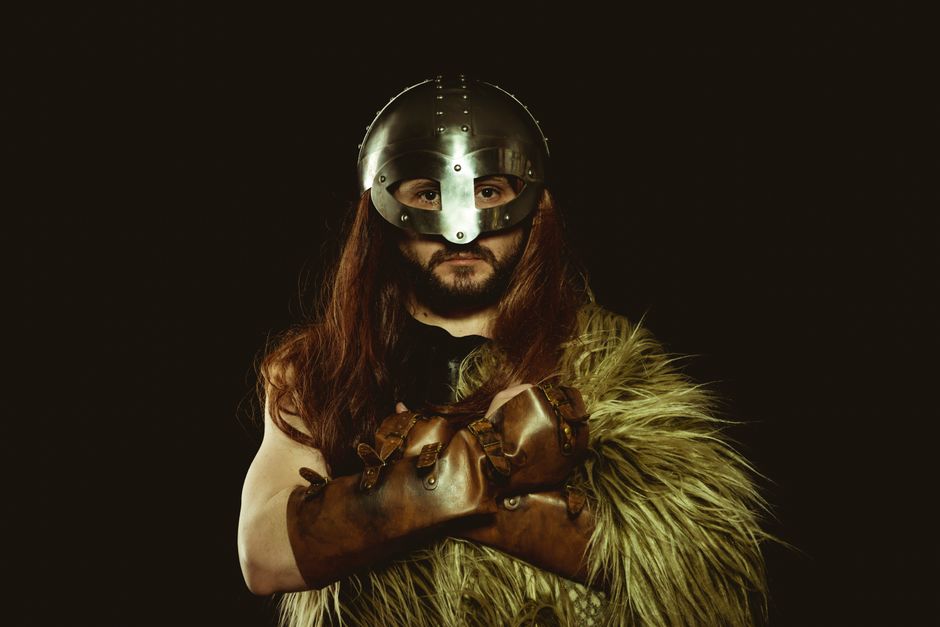
The Gjermundbu helmet is an important counter-image. Found in a tenth-century grave in Norway, it is commonly described as the only near-complete Viking-age helmet known from Scandinavia. Its iron components include a rounded cap and a protective framework for the face, with a distinctive spectacle-like guard around the eyes and nose. It has no horns.
That makes it a valuable reality check—but not a licence to claim that every Viking helmet looked exactly like this one. A single surviving example cannot represent every region, social group or moment across the whole Viking Age. Archaeology is shaped by what was buried, what survived and what has been found. Many people may have had no helmet at all; other forms could have existed without leaving a clear archaeological trace.
For game makers, the Gjermundbu find offers a strong starting point for evidence based props. Its form can inform a playable helmet without forcing every character into a replica. For players, it is a reminder that the most famous image is often not the best-supported one—and that an object in a museum case is evidence, not a complete inventory of an entire society.
Creative interpretation is not the enemy of history
Historical games are made by people who must turn incomplete evidence into playable worlds. They need to decide how far characters travel, how crowded a settlement feels, what a battle looks like and how much time the player spends on routine tasks. No archaeological record can answer every design question. Creative interpretation is unavoidable; the important thing is whether it is thoughtful.
A useful way to assess a game is to look at three layers:
- Material detail: Do the objects, buildings and clothing draw on credible sources, or do they rely mainly on familiar fantasy imagery?
- Social world: Does the game suggest a varied community with work, trade and relationships, or reduce everyone to warriors and targets?
- Presentation: Does the game signal when it is inventing, compressing or borrowing from later legend?
These questions are more revealing than a simple scorecard. A game can be careful about ship construction but wildly loose about chronology. Another can use invented characters and events while presenting its material culture with real care. Neither label—“accurate” or “inaccurate”—tells the whole story on its own.
What you see What to ask Why it matters A longship Is it suited to the journey and role shown? Ships communicate travel, trade and power, not just period flavour. A shield wall Is this a specific scene or a claim about every battle? A familiar formation can become an oversimplified picture of warfare. A horned helmet Is the game signalling fantasy, legend or historical fact? The myth is memorable, but it is not supported as standard combat gear. A richly dressed settlement Do the details suggest daily life as well as spectacle? Everyday objects can make a setting feel more human and grounded.How to enjoy the game and keep asking questions
Players do not need to pause every quest to consult an excavation report. But a little curiosity makes the experience richer. When something looks especially “Viking”, ask whether it comes from archaeology, later storytelling or a designer’s need for a bold silhouette. A resource such as HistoryMedieval can sit alongside museum collections and specialist writing as a starting point for following those questions; the key is to check claims against reliable evidence rather than letting a familiar image stand in for proof.
The same habit applies when games appear in commercial settings. A company name—whether HistoryMedieval, Mr Q or MrQ—does not, by itself, tell you how historically grounded a particular game or piece of content is. Look at what the work actually presents and how it distinguishes documented material from invention. Branding and historical credibility are separate questions.
If you are writing about a title, a Print Article (PDF/print function) can be handy for keeping a copy of your notes or sharing a longer review away from the screen. A Facebook share can help start a discussion, especially if you pair a striking screenshot with a question: “What here is evidence, and what is a clever bit of storytelling?” That invitation is more useful than declaring the whole game either a masterpiece of accuracy or a historical disaster.
So, what does historical accuracy mean for a Viking game?
It means judging the choices, not just spotting mistakes. The Gjermundbu helmet gives us a real object to compare with the horned fantasy version. Ships, shields and settlements reveal how visual shorthand can help establish a world while flattening its complexity. And games, unlike films, must establish that world at speed while giving players room to explore it.
Historical accuracy is about the relationship between a game’s claims and the evidence available. Authenticity is about whether its world feels coherent and inhabited. Creative interpretation can serve both, provided it does not pretend that invention is fact. A Viking game need not be a playable museum—but it is at its best when its spectacle leaves room for curiosity, and when the objects on screen invite us to ask what the evidence can really tell us.